

“All good writing begins with terrible first efforts. You need to start somewhere.” – Anne Lamott.
Picture this.
It’s 2 AM in England. Your proposal topic has been approved and dissertation deadline now is two months away. You’ve got fifteen browser tabs open, and a Word document that still says “Chapter 1” at the top.
You know what you want to say. You choose the topic.
But translating all that knowledge into a structured, coherent dissertation that earns an A? That feels impossible.
Here’s the truth most supervisors won’t tell you: brilliant research presented poorly earns average grades. Average research presented brilliantly earns distinctions.
Structure is more than justified text with Arial font and 1.5 line spacing. It’s the scaffolding that holds your entire argument together. It’s what transforms scattered ideas into scholarly excellence.
And that’s exactly what we’re breaking down today.
Whether you’re at Ulster University, studying remotely at a UK institution, or pursuing your doctorate anywhere in the world, this guide gives you the exact framework supervisors look for when awarding first-class grades.
Let’s dive in.
Why Structure Actually Matters (More Than You Think)

Before we begin the chapters, remember this one crucial point:
“Your supervisor will read dozens of dissertations. Maybe hundreds.”
Most will blur together into a forgettable mass of academic writing.
The ones that stand out? They have crystal-clear structure.
Structure does three powerful things:
1. It guides your reader effortlessly through complex ideas
Even the most brilliant argument falls flat when readers get lost. Clear structure acts like road signs, showing readers exactly where you’re taking them and why each stop matters.
2. It demonstrates intellectual maturity
Supervisors do not merely assess what you know. They assess how you think. A well-structured dissertation proves you can organize complex information logically, a skill that separates good scholars from great ones.
3. It makes your work publishable
First-class dissertations often become journal articles. Publishers look for work that’s already professionally structured. Get this right, and you’re not just earning a degree. You’re launching your academic career.
Now, let’s build that structure chapter by chapter.
Chapter 1: Introduction (Your Academic First Impression)
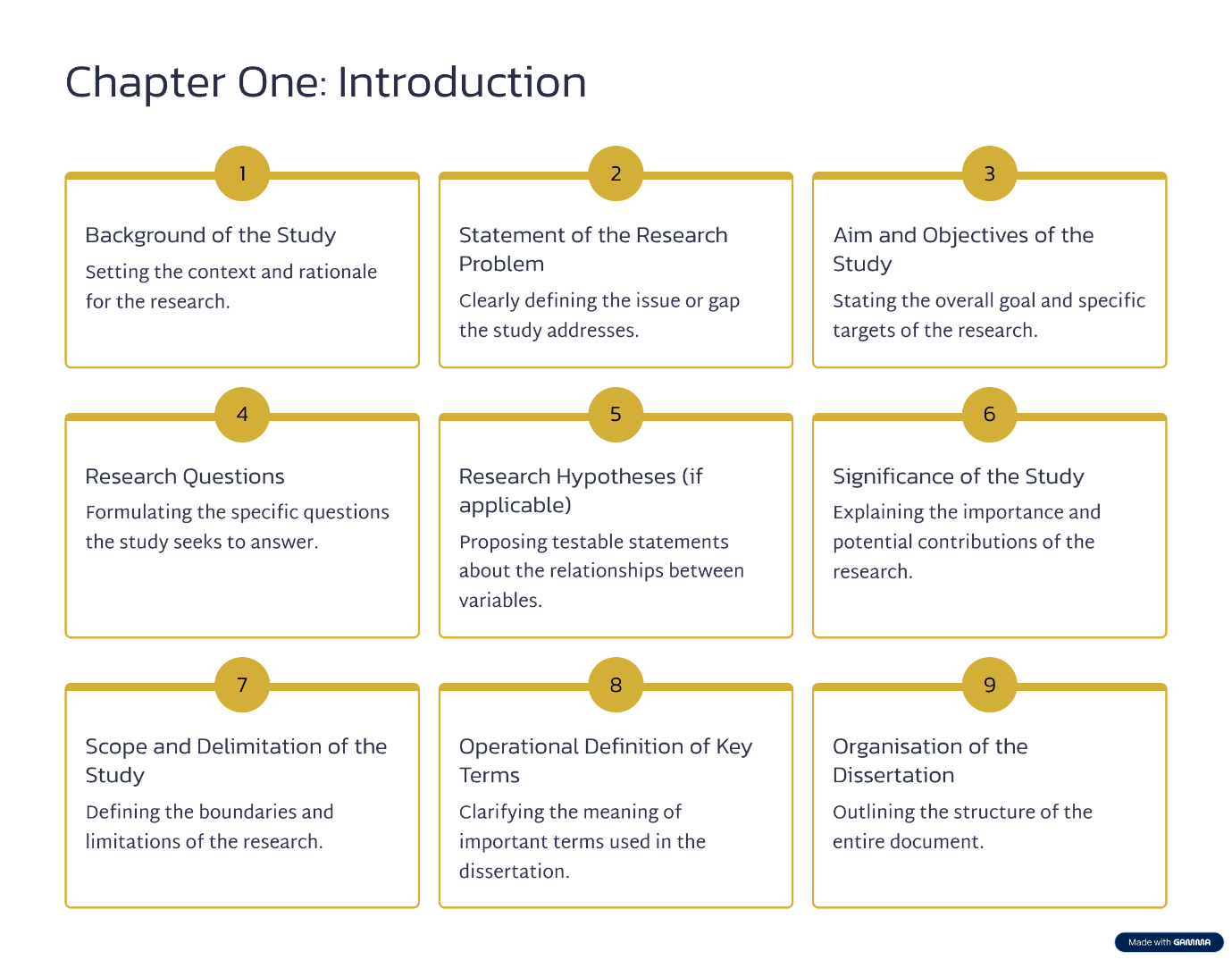
Think of your introduction as the movie trailer for your research. It needs to hook readers, set expectations, and make them excited to continue.
What goes here:
- Background context: Is there a short history? Why does this topic matter? What’s happening in the world, your field, or your country that makes this research relevant right now?
- Research problem: What specific issue are you addressing? Be precise. “Employee engagement is low” is vague. “Construction startups in the UK report 60% annual staff turnover despite competitive salaries” is sharp.
- Research questions or hypothesis: What exactly are you trying to discover or prove? Frame these as clear, answerable questions.
- Aims and objectives: What will this dissertation achieve? List 3-5 specific objectives that your research will accomplish.
- Significance: Why should anyone care? How will your research contribute to knowledge, policy, or practice?
- Scope and limitations: What are you covering, and what are you deliberately leaving out? This shows you understand boundaries.
Pro tip from successful students:
Finalise your introduction last. Once you’ve completed your research and know your findings, you can write a background context that perfectly sets up everything that follows. Draft a rough version first to guide your work, then rewrite it at the end.
Common mistake to avoid:
Don’t write a history essay. Get to the point fast.
Chapter 2: Literature Review (Proving You Know Your Field)
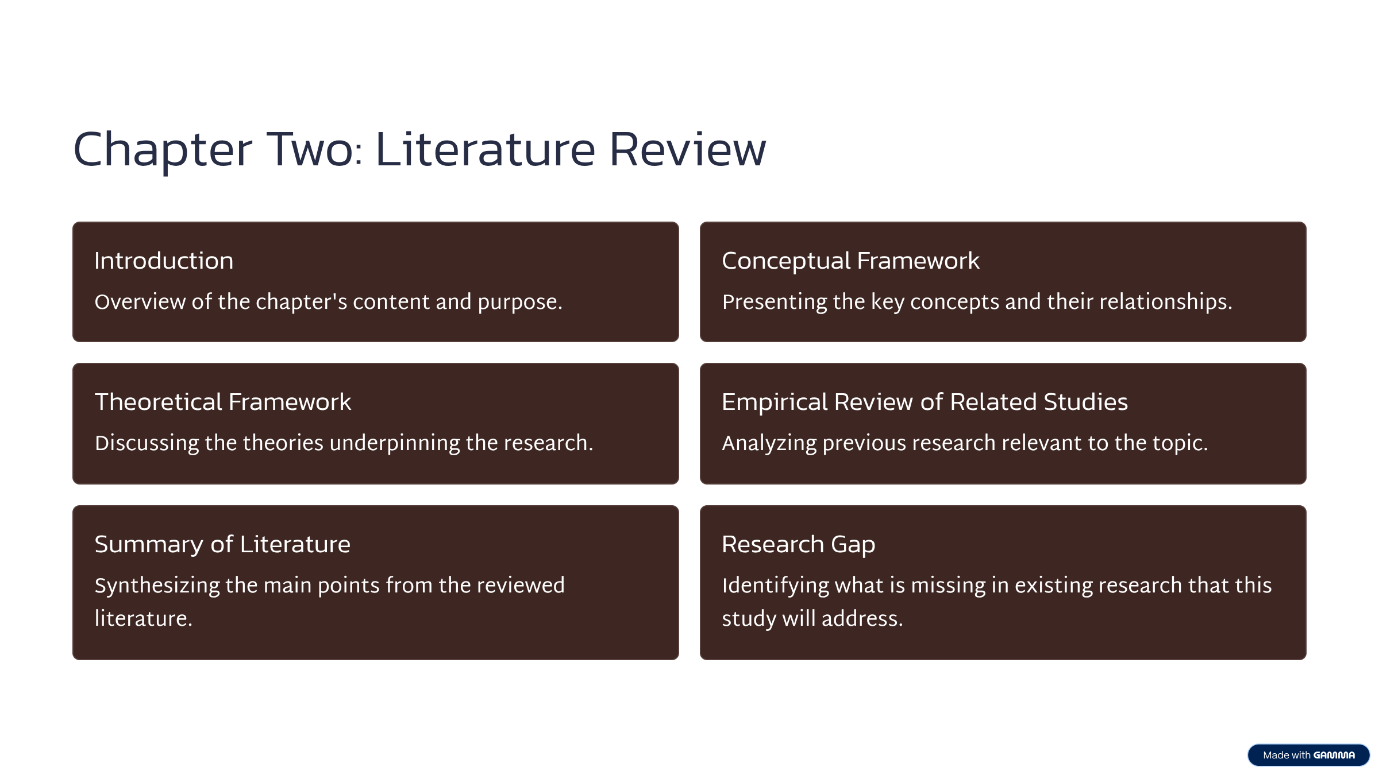
This is where many students either shine or stumble badly.
An A+ literature review isn’t a summary of what others have said. It critically analyses, compares, and synthesises existing research to build an argument for why your study matters.
What goes here:
- Thematic organisation: Group your literature by themes, not by listing one author after another. For example, if you’re researching remote work productivity, you might have themes like “measurement challenges,” “technological factors,” and “cultural differences.”
- Critical analysis: Don’t just say “Frank (2023) found X.” Say “Frank (2023) found X, which contradicts Oyedele’s (2022) earlier findings, possibly because Frank’s sample included more experienced workers.”
- Research gap identification: This is crucial. Show exactly what previous research has not covered. Your dissertation will fill this gap.
- Theoretical framework: What theories or models are you using to understand your topic? Explain them clearly and show why they’re appropriate for your research.
Structure that works:
- Start broad (overview of your topic)
- Narrow down (specific aspects relevant to your research)
- Identify gaps (what’s missing from existing knowledge)
- Position your research (how your work fills those gaps)
Pro tip from successful students:
Create a literature review matrix. Make a table with columns for author, year, methods, findings, and limitations. This helps you spot patterns, contradictions, and gaps that become the gold of your review.
Common mistake to avoid:
Don’t treat your literature review like a shopping list. “Hakin said this, Smith said that, Richard said something else.” Instead, weave sources together into a coherent narrative that builds your argument.
Chapter 3: Methodology (Showing Your Research Is Credible)
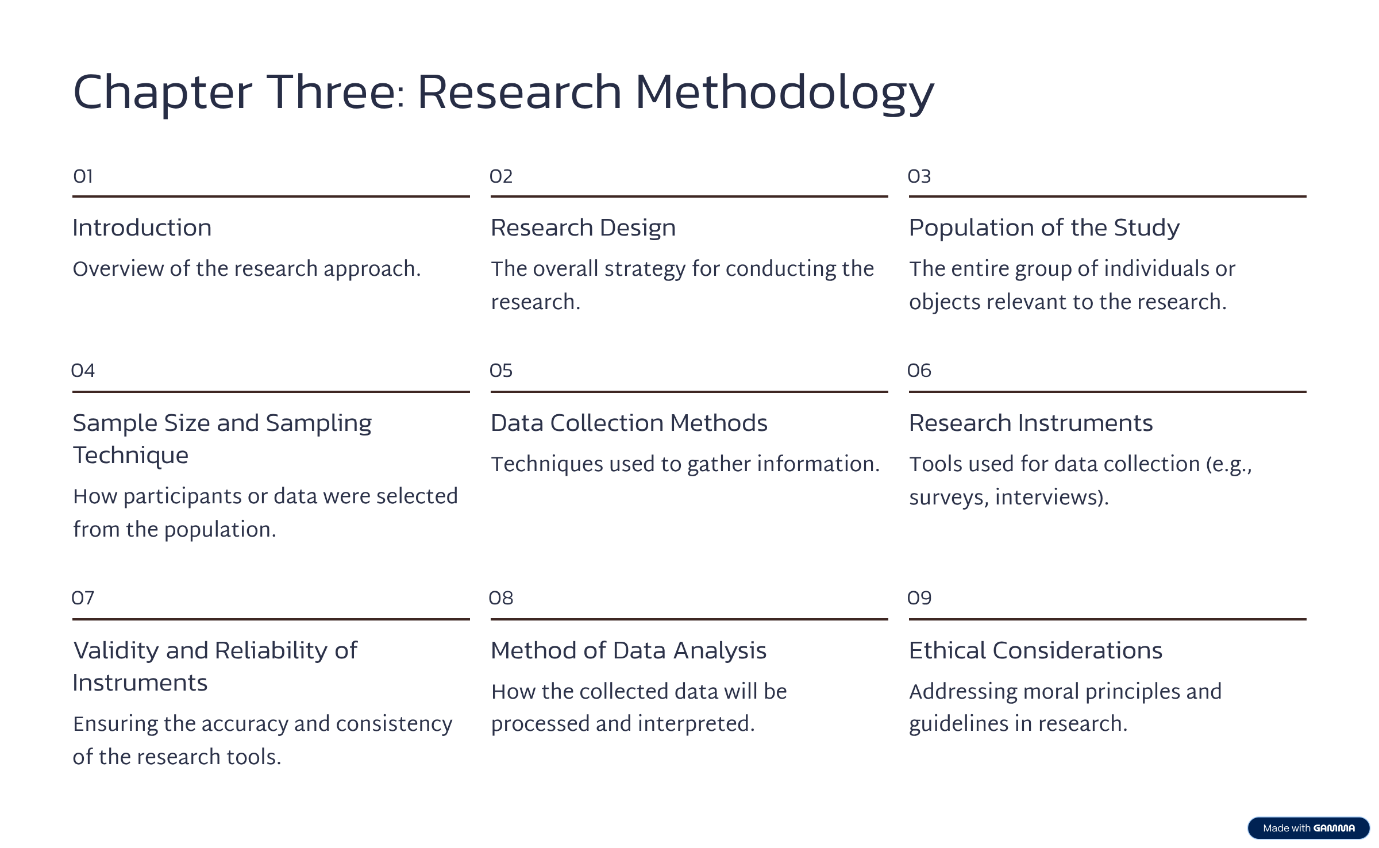
Your methodology chapter answers one critical question: “How do we know your findings are trustworthy?”
This is where you prove you’re not just making things up. You’re following established research methods that others can evaluate and, if needed, recreate.
What goes here:
- Research philosophy: Are you taking a positivist approach (objective reality, measurable data) or interpretivist approach (subjective meanings, qualitative insights)? Explain your choice.
- Research design: Is this qualitative, quantitative, or mixed methods? Why is this approach best for your research questions?
- Data collection methods: Exactly how did you gather information? Interviews? Surveys? Experiments? Document analysis? Describe in specific detail.
- Sampling strategy: Who or what did you study? How many participants? How did you select them? Why these specific choices?
- Data analysis approach: How did you make sense of your data? Statistical tests? Thematic coding? Content analysis? Explain your process step by step.
- Ethical considerations: How did you protect participants? Did you get consent? Maintain confidentiality? Get ethical approval?
- Reliability and validity: How did you ensure your research is trustworthy? What measures did you take to reduce bias?
Pro tip from successful students:
Adopt the Saunder Research Onion.
Common mistake to avoid:
Do not state methods like a shopping list. Justify every choice. Why interviews instead of surveys? Why 30 participants instead of 100? Every decision should have a clear rationale linked to your research questions.
Chapter 4: Results/Findings (Presenting What You Discovered)
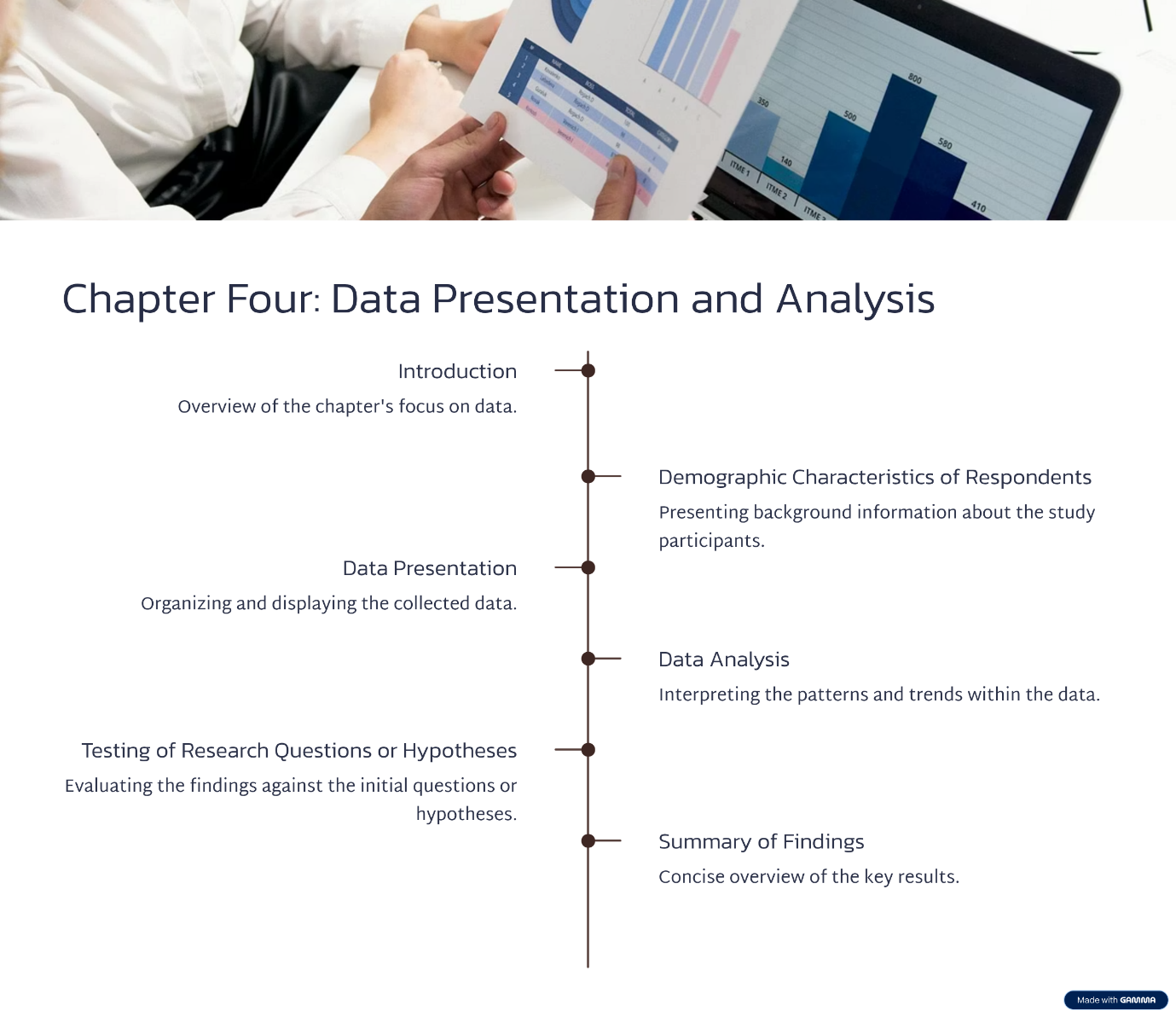
This is the moment your research has been building towards. What did you actually find?
Here’s the key rule for A+ results chapters: Present data objectively. Save interpretation for Chapter 5.
What goes here:
- Organised presentation of findings: Structure results around your research questions or themes. Take readers through findings systematically.
- Data visualisation: Use tables, charts, graphs, and figures to make patterns clear. A well-designed visual can communicate complex data instantly.
- Key patterns and trends: Highlight the most important findings without going into deep analysis yet.
- Unexpected results: If something surprising emerged, present it clearly. Don’t hide inconvenient data.
For quantitative research:
Present statistical findings with appropriate tests, significance levels, and confidence intervals. Use clear tables and graphs.
For qualitative research:
Present themes with supporting quotes from participants. Show how themes connect to your research questions.
Pro tip from successful students:
Label everything clearly. Every table, figure, and chart needs a number and descriptive title. In your text, always refer to visuals explicitly: “As shown in Figure 3, participant responses clustered around three main themes.”
Common mistake to avoid:
Don’t start interpreting here. If you write “This shows that employees are dissatisfied because…”, you’ve jumped into Chapter 5 too early. Stick to “The data reveals that 73% of employees rated satisfaction below 5 out of 10.”
Chapter 5: Discussion (Making Sense of Everything)
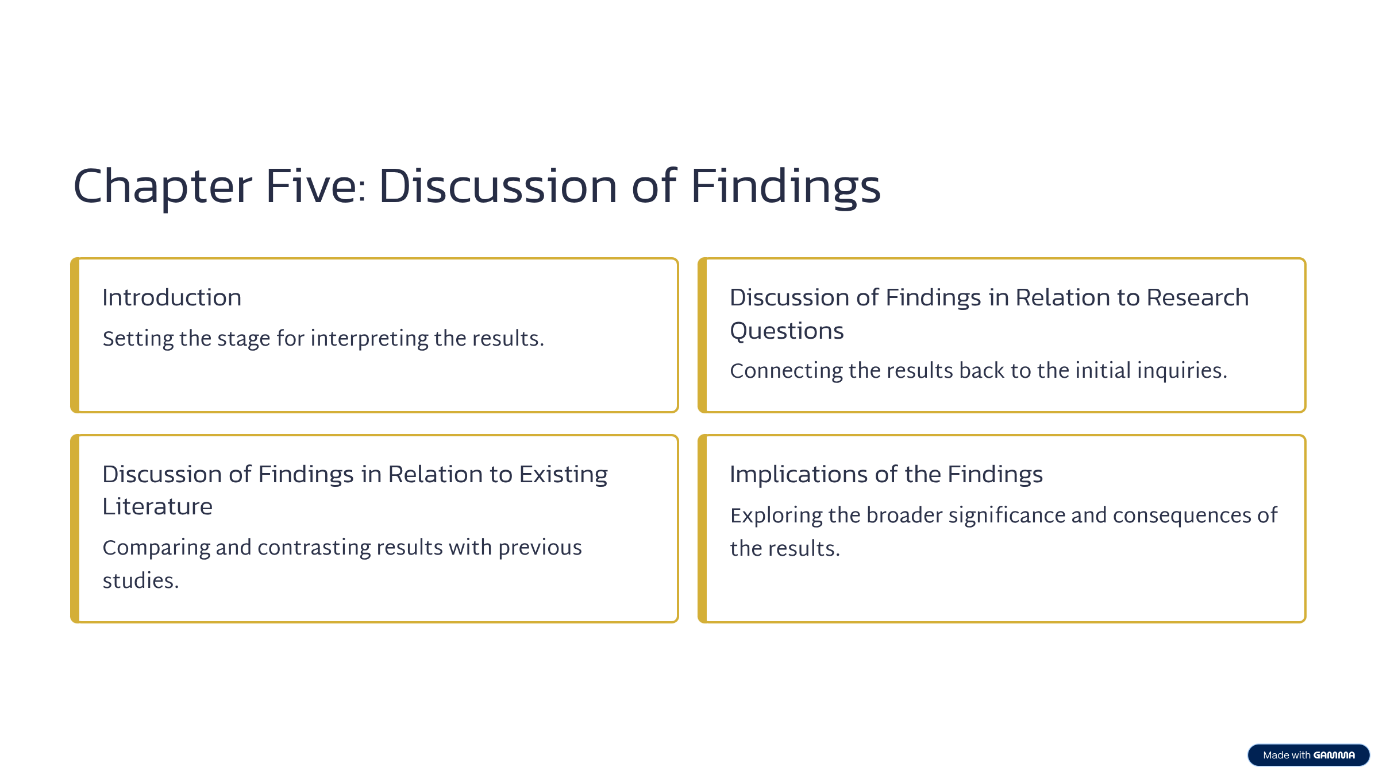
Now you get to be analytical, critical, and creative. This is where you move from “what I found” to “what it means.”
What goes here:
- Interpretation of findings: What do your results actually mean? Connect findings back to your research questions and literature review.
- Comparison with existing research: How do your findings align with or contradict previous studies? Why might differences exist?
- Theoretical implications: What do your findings mean for existing theories? Do they support, challenge, or extend current thinking?
- Practical implications: How can your findings be used in the real world? What should practitioners, policymakers, or organisations do with this knowledge?
- Limitations: Be honest about weaknesses. Did your sample size restrict generalisability? Were there confounding variables? Acknowledging limitations shows intellectual maturity.
- Recommendations: Based on your findings, what should happen next? What specific actions do you recommend?
- Future research directions: What questions remain unanswered? What should other researchers explore?
Pro tip from successful students:
Use the “So what?” test. After every major finding you discuss, ask yourself “So what? Why does this matter?” If you can’t answer clearly, dig deeper or cut it.
Common mistake to avoid:
Don’t introduce completely new literature here. The discussion should primarily build on sources you already reviewed in Chapter 2, not bring in dozens of new references.
Chapter 6: Conclusion (Ending Strong)
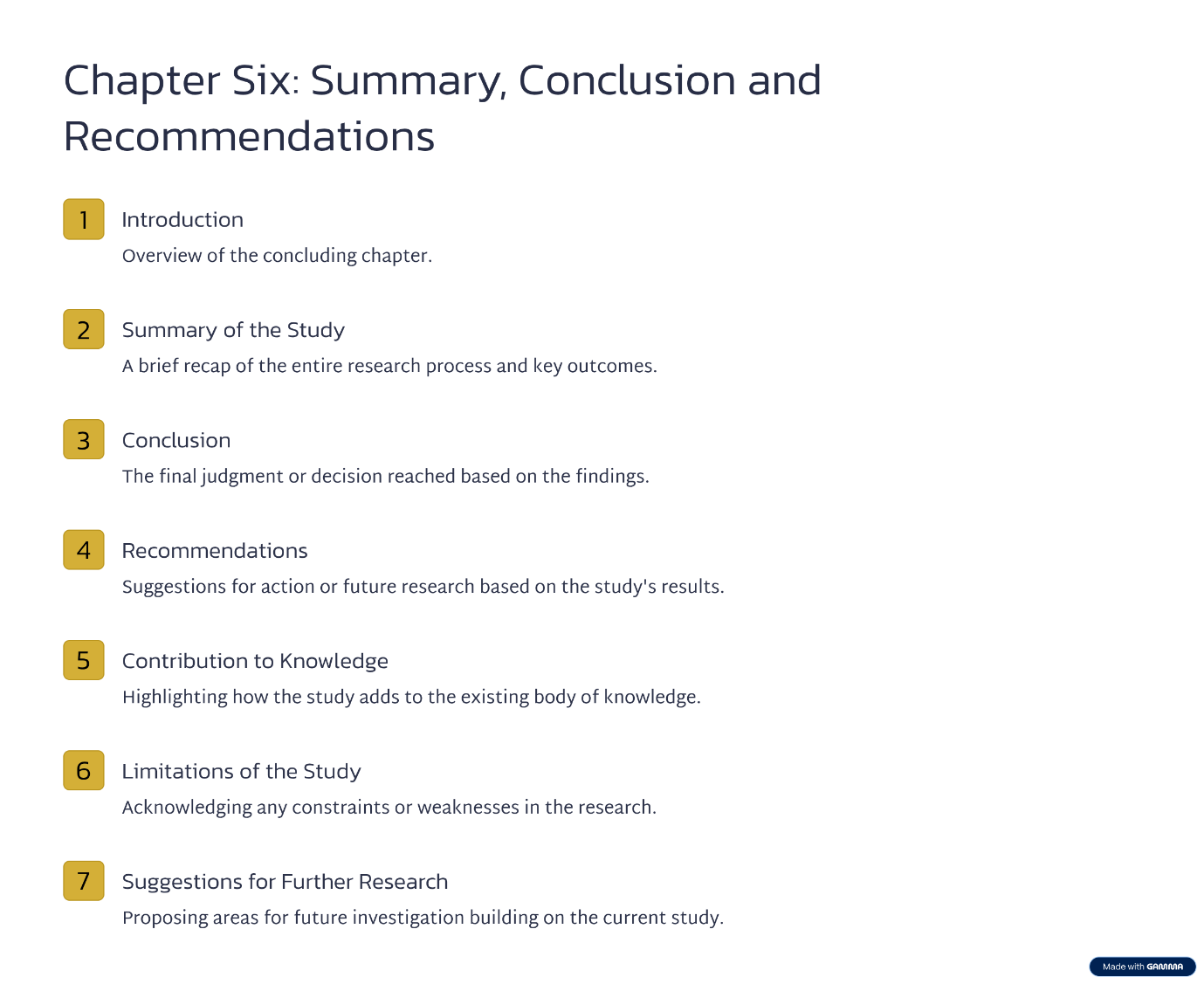
Your conclusion is your final chance to leave a lasting impression. Make it count.
What goes here:
- Concise summary of research: Briefly recap your research questions, methods, and key findings. One or two paragraphs maximum.
- Clear answers to research questions: Directly state what you discovered. Did you confirm your hypothesis? Answer your questions? Fill the research gap?
- Original contribution: Explicitly state what new knowledge your dissertation contributes. Don’t be shy about highlighting your achievements.
- Final thoughts: End with a memorable statement about the broader significance of your work.
What doesn’t go here:
- No new information or data
- No new references
- No lengthy explanations (save those for earlier chapters)
Pro tip from successful students:
Write your conclusion with confidence. You’ve done rigorous research. Own your contribution. Use phrases like “This research demonstrates…” not “This research possibly suggests maybe…”
Common mistake to avoid:
Don’t just copy-paste your abstract. The conclusion should provide closure and context that only makes sense after reading the entire dissertation.

The Secret Ingredient: Consistency
“Consistency is what transforms average to excellent”- Unknown
Consistency separates good dissertations from great ones
Throughout all chapters, maintain consistency in:
- Terminology: If you call something “remote work” in Chapter 1, don’t switch to “telecommuting” in Chapter 4.
- Tense: Use past tense for your research (“Data was collected”), present tense for established facts (“Research shows”).
- Formatting: Headings, spacing, numbering and fonts should be kept uniform.
- Citation style: Whether APA, Harvard, or Chicago, stick to one style rigorously.
Small inconsistencies signal carelessness. Supervisors notice.
How Inkventive Helps Students Structure First-Class Dissertations

At Inkventive, we help students worldwide achieve A+ dissertations.
“We don’t just write for you; we write with you”
Here’s how we support your success:
We write, then explain: We handle the writing and clearly walk you through the ideas, sources, and structure.
We refine together: Your feedback guides revisions until the work meets top academic standards.
Clear chapter structure: Each chapter is carefully planned for strong flow, clarity, and academic rigour.
Expert review and formatting: Qualified academic writers ensure first-class quality and full compliance with university guidelines.
Your Next Steps
Structure isn’t scary once you understand the blueprint.
Start with this framework. Map out what goes in each chapter before you write a single word. Build your dissertation section by section, knowing that each chapter serves a specific, essential purpose.
And remember: even the most accomplished researchers started exactly where you are now—staring at a blank document, wondering how to begin.
The difference between them and students who struggle? They followed a proven structure.
You now have that structure.
Need expert support to implement it? We’re here.
Contact Inkventive today at info@inkventivewriters.com and let’s transform your research into a first-class dissertation.
Inkventive Ltd – Professional Writing Services You Can Trust.